MTG: Tactile Closure. Why I Keep Going Back to Folding Phones
MTG: Three Attempts, Three Failures
Two years ago, I tried a folding Android phone and failed.
A year ago, I tried another folding Android phone and failed.
One month ago, I tried one again and, in the grand tradition of learning absolutely nothing, failed again.
My entire workflow lives inside Apple’s ecosystem. My apps are there, my passwords are there, my photos are there, and most of my habits have been carefully arranged around the assumption that I will continue using an iPhone until somebody pries it from my hands.
And yet I keep going back to folding phones.
Not because they make me more productive. They don’t. In many cases, they make me less productive. There are compromises, odd bits of software, extra thickness in the pocket and the constant awareness that something delicate is happening in the middle of the screen.
So why do I keep looking at them?
I think the answer is not the camera, the processor or the size of the inner display.
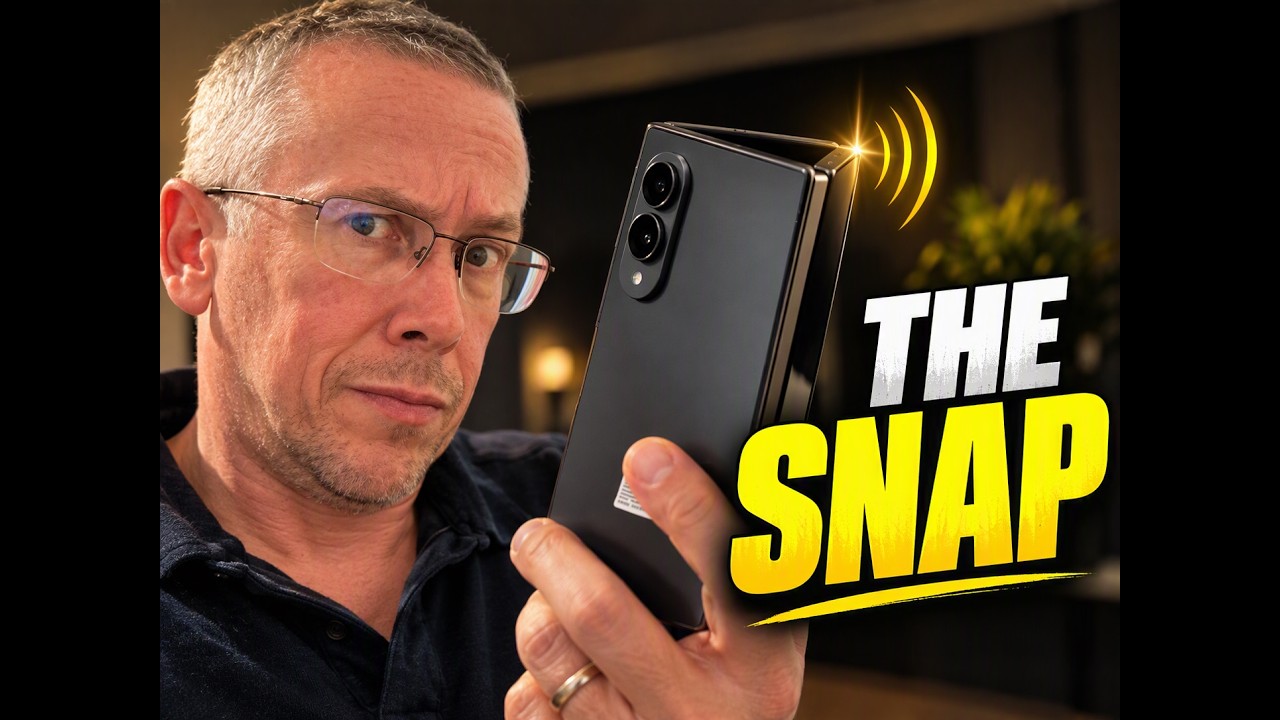
I think it is the little sound the phone makes when it closes.
That sound is a full stop.

MTG: What I Mean by Tactile Closure
I’ve started calling it tactile closure.
That is my phrase for the physical signal that tells your brain a task is finished.
When you shut a book, the chapter is closed. When you close a laptop at the end of the working day, there is a definite change in the room. When you turn a key in a lock, the door is no longer merely in the process of being closed. It is closed.
Your fingers feel it. Your ears hear it. Your muscles register the movement.
It is a small physical event, but it gives the mind something definite to work with.
There is established research into the way the brain organises tactile information and perceives completed forms through touch. That does not prove that folding phones improve digital wellbeing, or that every hinge is a miniature therapist. It does, however, make the wider idea less silly than it might sound at first.
A flat phone does not really close.
You press the side button and the display goes black, but the object in your hand has not changed. It is still the same thin rectangle. It is still ready to light up. The door to the internet has been dimmed, not shut.
You can put it face down, of course. You can turn on a focus mode. You can set a screen-time limit, although mine tends to be treated as a polite suggestion by both me and the phone.
But none of those things gives you the same physical sense of completion.
A folding phone does.
You finish reading, checking, replying or scrolling. Then you fold it shut. There is movement, resistance and a final snap. It is not a magic spell. The phone is still there and the internet has not been defeated.
But for a moment, the device feels dormant rather than available.
That matters.
MTG: The Book-Opening Test
Think about opening a book.
You do not normally pick up a book, glance at one word, shut it, open it, check a notification and then carry on reading while walking into a lamppost. Well, you might, but the book is not really designed for that sort of behaviour.
Opening a book is an intentional act. You sit down, open the cover and place two pages in front of you. The pages frame your attention.
An open folding phone can create a similar distinction.
When it is closed, it is a quick tool. Check a notification. Skip a song. See whether somebody has sent a message that genuinely needs an answer.
When you open it with two hands, the action makes a slightly bigger demand of you. It says: you are now choosing to engage with the larger thing.
I am going to read this article.
I am going to watch this properly.
I am going to look at this spreadsheet, although that may be pushing the definition of pleasure.
A normal slab phone blurs all of those activities together. Social media, banking, work emails and a long article all occupy the same flat piece of glass. The phone does not care what you are doing. It simply offers another rectangle.
A foldable introduces a little friction.
That friction can be inconvenient. It can also be useful.
It gives you half a second to ask whether you actually want to open the larger screen, or whether you are just following the well-worn path towards another forty minutes of scrolling.
MTG: Why Apple’s Move Could Change the Conversation
Folding phones have largely felt like an Android playground so far.
They have been enthusiast devices: interesting, expensive, slightly impractical and often bought by people who enjoy explaining the hinge to other people.
That could change if Apple’s much-discussed iPhone Duo becomes a mainstream product.
The price mentioned in my commentary is around $2,000, which is not an impulse purchase unless your impulses are unusually well funded. Cost will clearly be a major barrier.
I also refer to analyst expectations that Apple could take close to a quarter of the foldable market very quickly. Those are projections from the analysts being cited, not a promise from the future. The same applies to the estimate that foldables currently account for roughly 1.5 to 2 per cent of global smartphone shipments.
The point is not whether those exact numbers turn out to be right.
The point is that Apple entering the category would put the idea in front of millions of people who have never seriously considered a folding phone.
It would also change the social permission around the category. As Andrew sees it, Jon Prosser and Sam Kohl, tech commentators known for commentary on Apple and mobile hardware, have publicly talked as if they would never touch a folding phone even if Apple made one. Now some of them are saying they might. That does not prove anything on its own, but it does show how quickly the conversation can shift once Apple is involved.
And Apple would not need to explain the hinge as a piece of engineering.
It could explain the feeling.
We have seen this before in other areas of technology. People moved from flat plastic laptop keys to mechanical keyboards because the action felt better. They moved from wired earphones to wireless earbuds despite the cost and the risk of losing one down the back of a sofa.
Once you experience a better physical interaction, the old way can start to feel strangely incomplete.
That is what interests me about folding phones. The appeal is not simply that the screen gets bigger. It is that the device changes state.
Open means active.
Closed means finished, protected and put away.

MTG: The Unromantic Bits
Now, before this starts sounding like a sales pitch, let’s deal with the irritating parts.
Opening a folding phone usually needs two hands, or at least makes life easier with two hands. That is not ideal if you are carrying a coffee, holding an umbrella or trying to read a map while walking somewhere you have never been before.
The device is thicker in your pocket.
There is a hinge. Hinges move, and moving things can collect dust, wear out or become the bit you worry about when the phone lands on the floor.
There are layers of delicate display technology that need more care than a standard slab of black glass.
And the crease? It may become less noticeable, but it does not entirely disappear just because a marketing department would prefer it to.
Sometimes the physical friction is helpful.
Sometimes you are standing in the rain with one hand occupied and it is simply annoying.
That is the honest trade-off. The psychological relief of closing the phone has to be worth the inconvenience of using it. For many people, it will not be. A normal phone is thinner, simpler and more reliable. There is a lot to be said for boring when boring is in your pocket and contains your train ticket.
But if you are feeling digitally burnt out, the compromise begins to make more sense.
MTG: The Pocket Has Always Understood This
This is not really about nostalgia for old flip phones.
It is about the way objects have traditionally been designed.
Pocket knives fold. Spectacles go into cases. Pocket watches have covers. Matchbooks close. Small tools are normally protected when they are not being used.
When a tool is open, it is active and vulnerable.
When it is shut, it is compact, safe and dormant.
For the past fifteen years or so, smartphones have broken that rule. We have carried an active window into the entire internet in our pockets with no lid, no barrier and no genuine end-state.
We have then tried to solve the resulting problem with software.
Screen-time limits.
App timers.
Grayscale modes.
Focus settings.
Those tools can help, but they are fighting the physical design of the device. The hardware is still a permanently available piece of glass, and the software is asking us to behave as though it has a door.
A folding phone gives the door back.

MTG: Hardware Sets the Boundary
This is why I keep going back, even after three failed attempts.
I am not convinced that folding phones are automatically better. They are not. They are not necessarily more productive, more durable or more sensible.
But they may be better at creating a boundary.
When you want to be connected, you open the device.
When you want to return to the real world, you close it.
That physical action will not cure digital distraction. It will not stop me checking the weather when I already know what the weather is doing. It will not prevent one quick message becoming an evening lost to the glowing rectangle.
But it gives the end of the interaction a shape.
And perhaps that is the real reason folding phones keep pulling me back. Not because I need a larger display, but because I miss the feeling that something is actually over.
The question, then, is fairly simple.
Is that satisfying little snap worth the extra cost, the extra bulk and the occasional irritation?
I’m still not sure.
But I am still looking.
if anything I've said today struck a chord with you and you'd like a chat or if you have a particular challenge with energy, power & infrastructure, business generally or you might like to use the studio, drop me an email at andrew@aelhawley.com - if you've watched the video version of this blog you can drop a comment below and, I think I'm supposed to say like and subscribe but I won't. See you on Sunday in the field.. that to be clear, isnt my garden.